
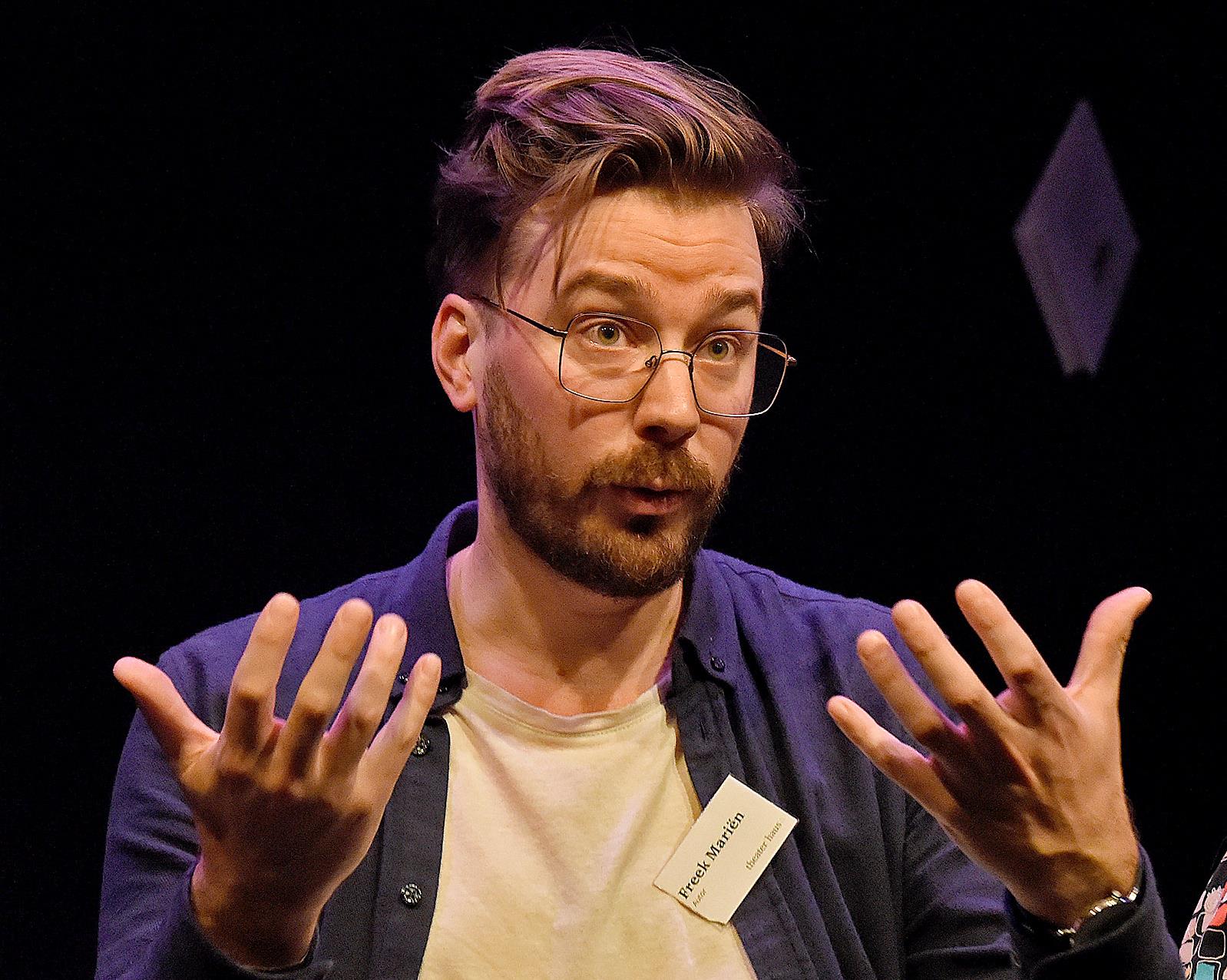
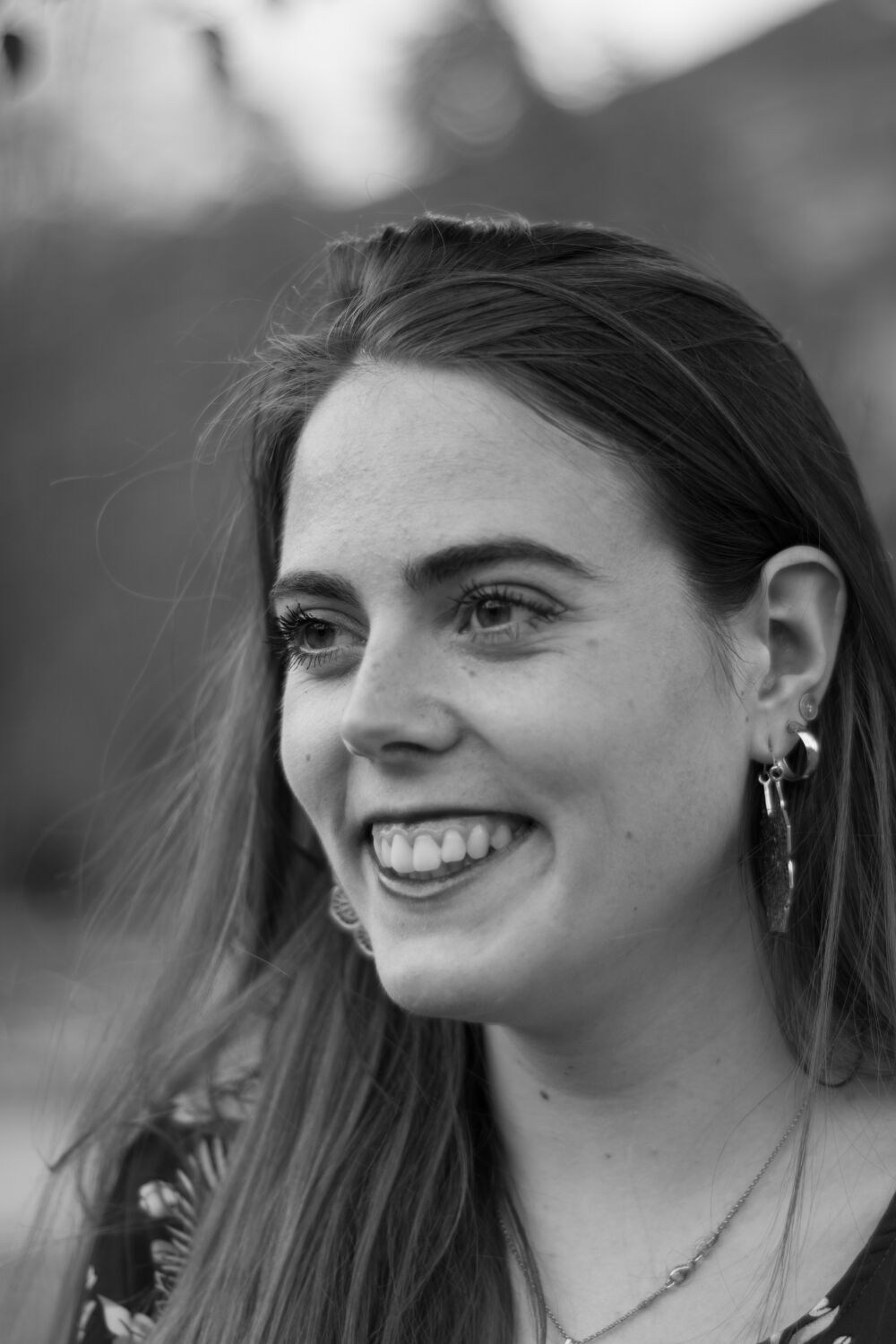
Fotos: Autor Freek Mariën bei der Diskussion in Mannheim, © Thomas Troester; Lorena Pircher, EURODRAM, Interview; © privat
Zurück zu Vorstellung der Auswahl 2023 beim DrmatikerInnenfestival in Graz.
Das Interview mit Freek Mariën führte Lorena Pircher anlässlich der Vorstellung der Auswahl 2023 EURODRAM beim DramatikerInnenfestival in Graz am 24.06.2023
Lorena Pircher: How would you describe your entry into the theater world, your artistic development as a play writer?
Freek Mariën: My entry in the theater world… Well, I actually started my first theater company when I was about eight years old (laughs). Me and some friends wrote plays and we produced them, if one can say so. We rehearsed during playtime, and we performed them in the classroom. It was just kids play, but it also says something about what I wanted to do.
My actual playwriting started in the final years of high-school, when I was 16. I had to choose a course, and was the only one of my school to pick the art related subject. First they told me that course wouldn’t go on with only one student, but eventually it became a solo project: I had to rework a classic theater play. That’s when I decided to rewrite “Othello” from the viewpoint of Iago — and in doing so, I actually learned writing theater.
Afterwards I started drama training in Ghent at the Royal Academy of Arts (KASK), which is more of an actor-based training. Nevertheless, I never stopped writing, and, after graduating with a play that I had written myself, I decided that I wasn’t going to act in my own plays anymore and to focus on being a writer.
L: Like experimenting, evolving, following your own artistic way.
F: Exactly, it was and it is a journey and I still have the ambition, with each text that I write, to become a better playwright. Because there’s always something that’s still nagging you about a previous text.
L: This is great, I think this attitude is vital in order to constantly improve one’s writing. From where would you say you draw inspiration? Are classical plays and their rewritings a source of inspiration to you or do you prefer current topics, reading newspapers for instance?
F: I think there are two main things that inspire me. A lot of plays are born out of frustration with the society we have at the moment and out of the aspiration to create a better world.
I think my plays can be partially seen as thought experiments. For instance, I ask myself: imagine some people living in a room with their own customs and rules, unaware of the existence of an outside world. What would happen, if suddenly someone enters this room with a completely different set of customs and rules?
In these plays, which are at the same time abstract and crystal clear in their story, you can refer to so many political aspects and so many problems of society, through different uses of language, but in a subtle way. I like to choose closed societies as settings for my plays, where thought experiments become reality.
L: This reminds me a little bit of “Huis Clos” by Sartre …
F: … yes exactly, or what Saramago writes in “Blindness”: what would happen if people suddenly started to go blind without reason?
Then, aside from the ‘thought experiments’ I also write plays that are based on reality, but they always come with a twist that lifts them out of realism. It happens when I stumble upon a fact or story which, in my opinion, carries a whole world in it. For instance, the idea for “De Gemoederen” (“Uproar”), a recent play of mine, came to me while I was reading a book about the breeding of the Lipizzaner horses …
L: Oh, really?
F: Yes, I’m not that interested in horses, but I was interested in its focus on genetics. So historically, it started with the horses, but then they thought, hey, couldn’t we apply this same logic to people? In this book, there was an overview of all the measures which different countries took in the 20s and 30s with regard to eugenics, with one line mentioning that in 1923, Denmark decided to banish all “erotically imbecile women” — that’s the term they used — to an island to keep them out of the gene pool. This shocked me and stuck with me. And so I started doing some research and at the same time, Bolsonaro and Trump were elected and there was this whole rightwing, conservative atmosphere growing. So I decided to write a play to examine how such a decision, to banish a significant amount of women to an island, could be made again today. A play with only men around a table, played by an entirely female cast.
So in a way, this play is based on facts, but it still has that hint of thought experiment in it.
L: Your prize-winning play “The Wetsuitman”, is clearly also based on the problematic behavior of today’s society and the unjust decisions of Western politics?
F: Exactly. “The Wetsuitman” is inspired on an article I read, which talks about two refugees who tried to swim to England. One ended up in Norway, the other one in the Netherlands. The article focussed on the search for their identities. I noticed that this story kept coming up in my mind in the months afterwards, attaching itself to things I read or saw, even if they didn’t have any direct relation to refugees. But it became more and more clear to me that everything had to do with identity. How we deal with identity, and how this fictional constructs have real life consequences.
Then the formal aspects came into play. I ask myself: If I want to write about this specific topic, what language does it demand? What structure is needed? If you look at my plays, they can be quite different, not only in their content, but also concerning the style and the language I use. Once, for instance, I wrote a play with Carl von Winckelmann, where the protagonists are young, at the beginning of puberty, and full of self-doubts. This translated itself to a text with only incomplete or grammatically incorrect sentences, as if the characters are already second guessing themselves while speaking.
L: Because it reflects the perspective of a child, and the self-doubts are mirrored in the fragmentation of the language.
F: Indeed. With the “Wetsuitman” I played with different literary genres within the play, and a multitude of characters — all these different identities and perspectives.
The story evoked all these thoughts about identity, how we think about groups, and how prejudice operates. So I thought, I’m going to use the expectations that certain genres of theater imply and use these expectations, — this prejudice if you want — ‘against’ the audience. So I start the play as a pastiche on a “whodunit”, and you are thinking, this is funny, this is safe for me to watch, it’s not going into any political or emotional dangerous zones. So you relax. But each act, the genre, the setting and the characters switch, and before you know it, you are in the home of a mourning Syrian family in the middle of a war zone.
Being caught off-guard, it forces the viewer to reflect through feeling. And this is something I would like to achieve with all of my plays.
L: Thank you so much for your time and the interesting conversation.