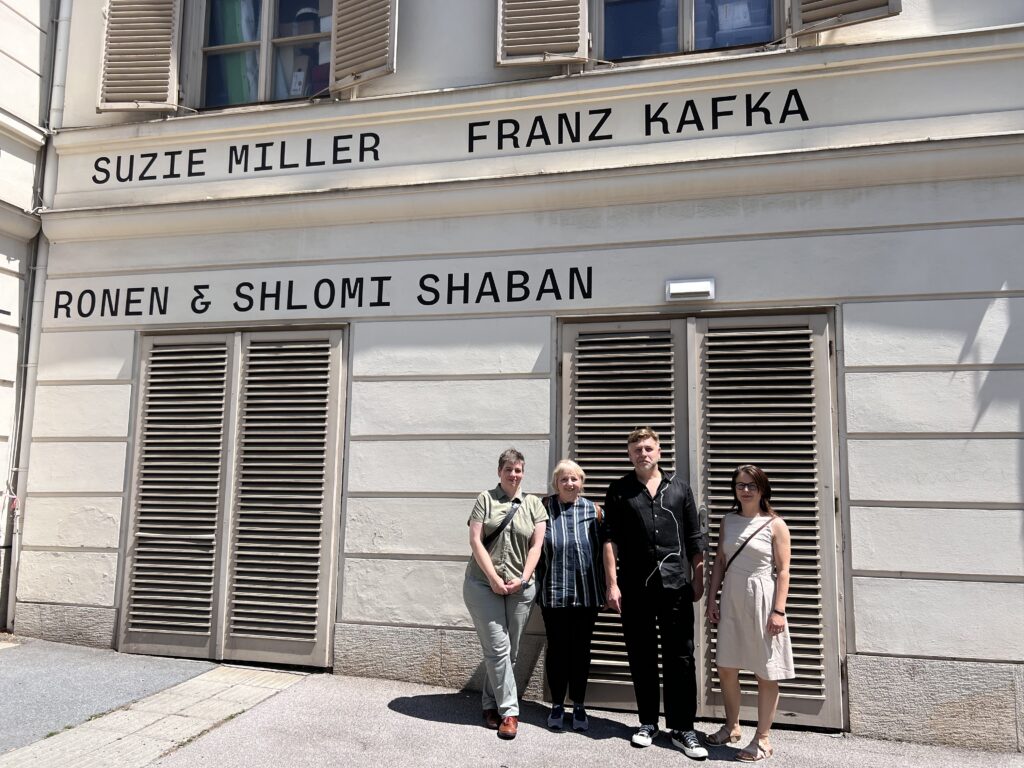
From left to right: Johanna Marx, Claudia Zecher, Marius Ivaškevičius, and Ruth Altenhofer/ Dramatists’ Festival Graz 2025 (c) Eurodram
Ana Ristoska Trpenoska (ART): The play Rise of the Gods: A Theatrical Investigation of a War Crime is based on the true story of Lithuanian director Mantas Kvedaravičius and explores the theme of violence, not only during war, but also gender-based and systemic violence that has been normalized.
Marius, what was your personal motivation for writing this play while the conflict in Ukraine is still ongoing? Did you write it to reach a foreign audience, to raise awareness, or was it a personal need to make a statement about war and violence, and perhaps to confront your own trauma?
MI: The answer would be complex. When the war started on 24 February 2022, I think most artists had this feeling, at least in our region, that we were paralyzed. And for me, I not only saw no sense in doing something, but I also no longer saw any sense in the things I did before. It looked like the world had totally changed, in another direction. I was writing essays for the Frankfurter Allgemeine Zeitung quite often, and then in the first weeks of the war, when they asked me to write my reflections on the war, I said I was sorry, I couldn’t, I just couldn’t say anything.
Before the war started, we were invited to the Avignon Festival with our previous performance, which was based on the events of the Belarusian revolution of 2020. Then, in the middle of March, they said, look, we don’t have anything about this war in our Avignon program, and maybe you can add a little bit about the war in Ukraine to your performance. I said, sorry, how do you imagine adding an elephant to a fly, or something like that. So, then the next request was maybe you can do something fast and present it at the Avignon Festival.
First of all, I didn’t really find arguments why I, as a Lithuanian who is not in the war and not in Ukraine, should tell the story of the war to the French and to an international audience in Avignon. So, at the beginning, I couldn’t find this motivation inside myself. But then there were refugee actresses from Kyiv, four of them, who came to Vilnius, and we started to meet. I saw how important it was for them to do something about this war.
We started to meet every day to talk. They were bringing different materials, from their friends, from their own experiences, but still it was many stories, not something like a whole play. And then suddenly came the information that the documentary filmmaker Mantas Kvedaravičius was killed in Mariupol. I knew him, we were not close friends, but Lithuania is a small country, so all artists know each other. I hadn’t seen him for the last five or six years because he was living in Greece and in Uganda. When this information came, I felt that through his story I could talk about these horrible events in Ukraine. I didn’t know about his girlfriend Ana, who is the main character in the play, but from the press I heard that she brought his body home to Lithuania. I called my friend, a film producer who knew Mantas very well. I said, maybe you know how to find Ana. He said, oh yes, she is in my flat now. So, we met, and in a few days, we recorded a long interview with her, and after that I wrote it. At the beginning, it was like, you feel that you have to do something, but you cannot…
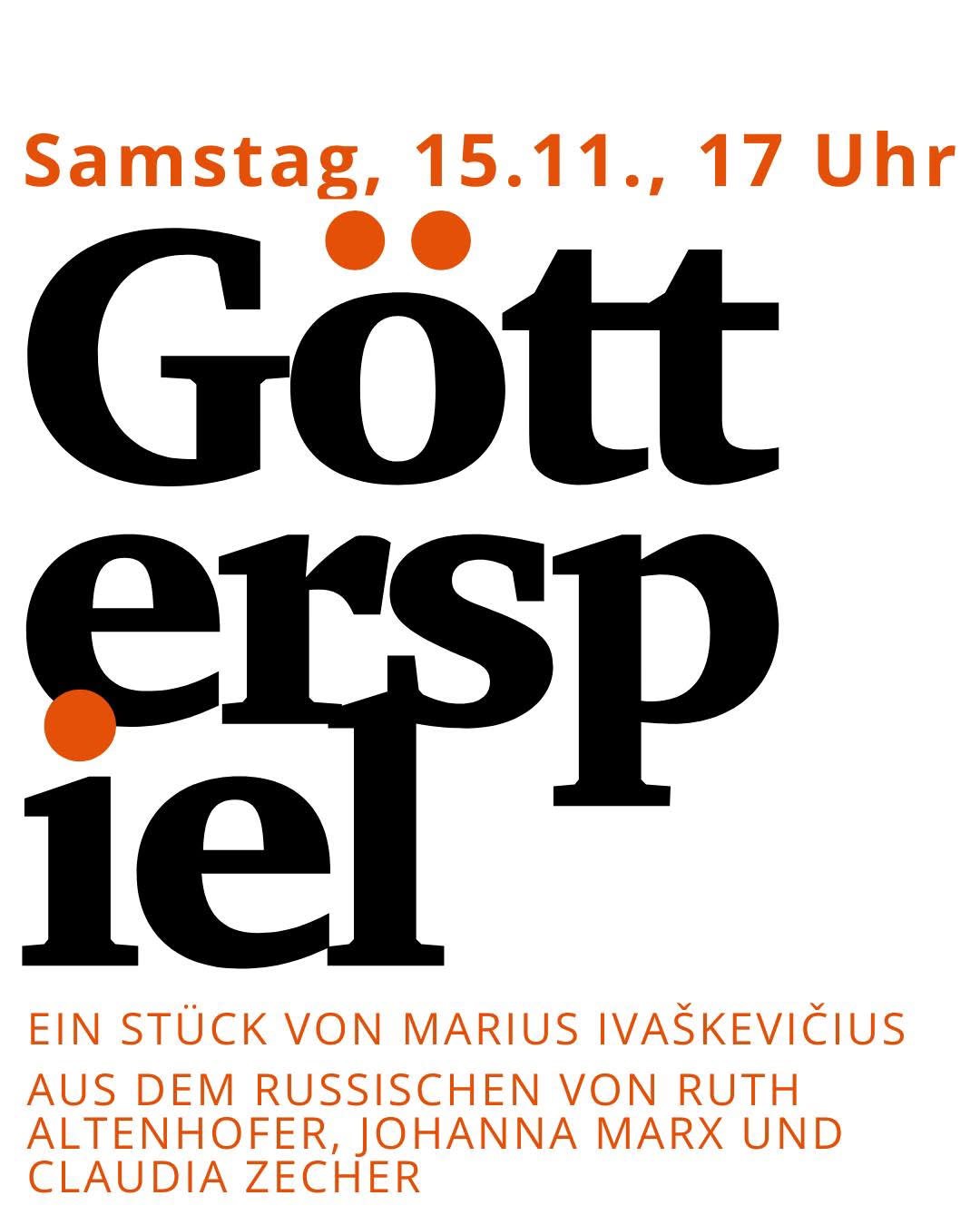
Rise of the Gods (Götterspiel) was selected by the EURODRAM German- language Committee; Selection 2025.
ART: The play was translated from Russian into German. Do you speak and write both Lithuanian and Russian?
MI: No. My native language is Lithuanian, but in 2013 I kind of started quite a big career in Moscow, when they started staging my plays in the theatres. There was an idea to write a play about Leo Tolstoy, and for me it was an experiment: could I write it in Russian? And I did it. So, after that I got this feeling, it’s like playing with another instrument that you don’t know. I can write theatre plays, but I cannot write prose in Russian.
ART: Rise of the Gods recently premiered at the Russian Theatre of Estonia, with two separate premieres in Russian and Estonian. Although there was one director, these are two different productions, correct?
MI: Particularly for this play, there is a reason why I wrote it in Russian, because all the material was mostly in Russian, the actresses, our interviews with them, they all spoke Russian. So, there were two possibilities: either I translate it into Lithuanian, being aware that I would lose something, or we do it in Russian.
For the staging in Estonia, something really interesting happened. I think it was the first time in a Russian drama theatre to have a performance in the Estonian language. And it became a kind of scandal, because the Estonian version of the play was totally sold out. I think there were five performances. The Estonian audience, which had never been coming to the Russian theatre before, came to see this show. But for the Russian version and the Russian audience, who normally go to this theatre, the sales were like 40 percent of the hall. So now there are big discussions, and this play has become like an indicator for Estonian Russian society, opening the question of who they are. Are they mostly Putinists, or how do they define themselves?
ART: What is the future of these two productions?
MI: They are going to play it next season. First there was the Russian version, the opening night, and then the Estonian one. So, I saw the Russian version, and it was really very well made. And I know that for many of these actresses, there were not only Russians but also a few Ukrainian actresses, and for those Russian actresses, those were not just roles, but also a way of showing their moral stance on this war.
Somebody even told me, and I included this in the story, that a girl, an actress, called her father and told him: “Dad, I am starting this project, which will probably mean I won’t be allowed to go back to Russia again, even after the war.” And the father said to her, “I am proud of you.” So, for most of them it was kind of showing their position. But I am afraid that this Russian version might be closed soon because of the audience. So, if they don’t have an audience, they won’t have a show.
ART: Is there currently any interest in staging this play in German-speaking countries? Do you think that Central and Western Europe shows interest in authors and works only specifically tied to war conflicts? Do theatres in these regions show solidarity with colleagues from Eastern Europe only when war or political events occur, or is there an ongoing dialogue and collaboration?
MI: So, first question: No.
I think, especially at the beginning of the war, when I was in Berlin, there were three or four events with different Ukrainian authors’ readings based on the war. So, I really saw German institutions giving space for them, but the problem was that most of the audience, eighty or even ninety percent, were Ukrainians, Belarusians, Russians, and very few Germans.
I understand that people don’t want to go to the theatre to see what they see every day on the news, but I think that theatre really has this power to show it in another way. I mean, if news goes like through your mind, theatre can go deeper into your emotions. I could experience it with this play: when we showed it in Avignon ten times, and it was the first sketch of the play, I saw how people went out with emotions, somebody was crying, somebody was hysterical…I think that if Ukrainian dramaturgy was unknown before the war in Western Europe, and even in Lithuania, now it has become known. There are many readings, many shows in big theatres of Ukrainian authors. So, I don’t know if there is interest, if behind this interest is a structure, theatre houses, or if it is the interest of the audience. That’s maybe the question.
I think it was, and it always will be like that, it’s how Europe works. It looks at Eastern Europe a little bit down. But it’s the same case: I have been working already three, four years in a festival in Narva, an Estonian Russian-speaking city, where we are doing a big festival and bringing shows from even further east. For example, last year the festival was focused on Central Asia, where we don’t know anything about the theatre. So, we went to all five countries looking for shows, and because our festival has the topic “Freedom,” we were looking for something that would be about freedom even in these authoritarian countries. And we found them. We brought them, and some of them are touring in Europe now. Yes, but somebody has to do this research.
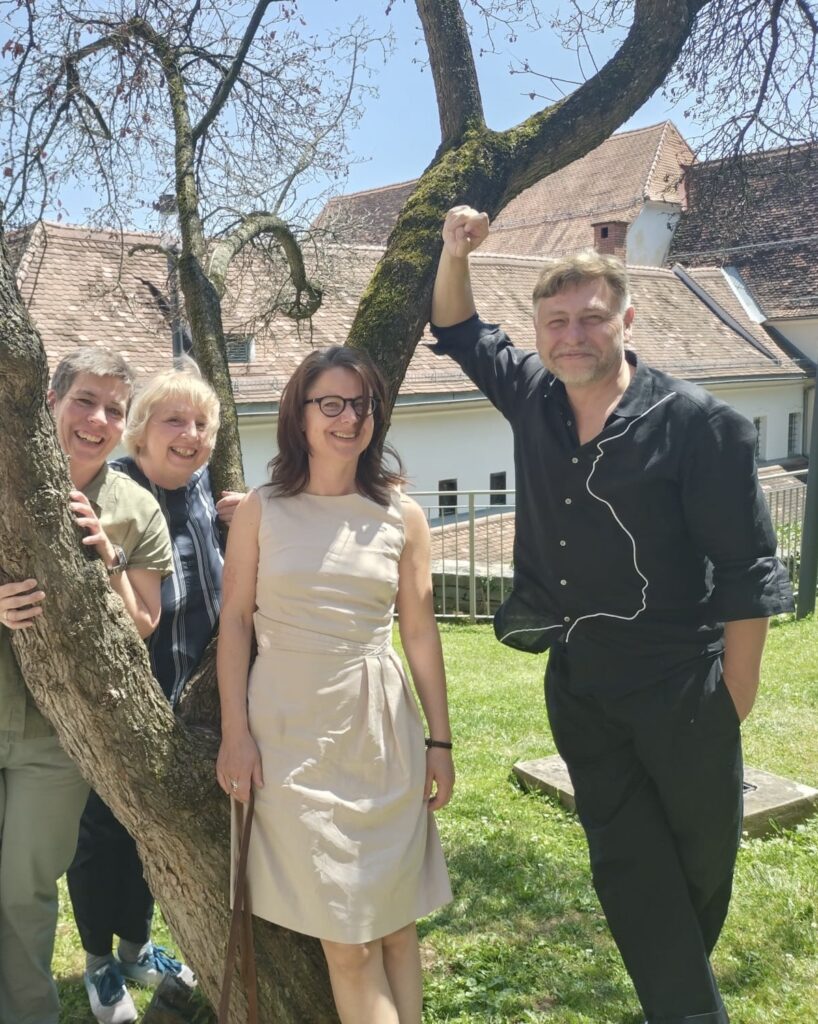
From left to right: Johanna Marx, Claudia Zecher, Ruth Altenhofer, and Marius Ivaškevičius/ Dramatists’ Festival Graz 2025 (c) Eurodram
ART: I would like to extend this question to the translators as well. Ruth, Claudia, and Johanna, what has been your experience? Does the content of a work influence your personal choices when deciding whether to translate it?Once a work is translated, does it have a better chance of being staged if it deals with war-related topics? How did the idea to translate this particular play come about?
CZ: In this case, it was the Echo Lubimovka Festival, they wanted to have it translated. They found Ruth, and it was a short period. So, she found us to translate it together because we had only ten days or twelve, something like that. We started to translate it in cuts and then we shared it among us for proofreading. If you have a short period to translate, proofreading is also very important. So, in this case, the short period played a big role.
RA: It’s not that we think “Now I want to translate something about feminism or something about war”, we rather get the opportunity to translate something for a festival, for example. And then we sort out the things we don’t want to translate, either because of the content or because they’re not translatable. This was the case with a second play for that festival …
CZ: … which had a hundred cultural codes you couldn’t translate.
JM: In general, we are not very selective, and I think that since the war began there are not so many translations from Russian. I have the impression the number of translations is shrinking. So, there isn’t much to choose from, to be honest.
CZ: But in this case, it was the play that… I have been translating for the last 20 years, but after reading this play I could not sleep, and I saw the pictures in my dreams for weeks, every night…
RA: And it’s some kind of happiness when you translate something which is worth translating, an important text…
JM: which is not always the case…
CZ: The three of us have the same feelings about this play.
ART: How does it work for the three of you to translate a play together?
RA: This was the first time that the three of us worked together. We have known each other for fifteen years, but we never have worked together. So it was also about finding out how to work with each other. With Claudia and Johanna, I have the feeling that they have ten years more experience.
CZ: No, not so much. But the two of us have worked together earlier. So that’s why we knew how it is to work together; we just didn’t know how it would be to work the three of us.
JM: I just remember the online Excel sheet we had, and writing in the sheet at the same time: “How do we translate this? Let’s do it this way,” and then discussing things at the end…
RA: After this collaboration, you don’t remember anymore, which part was translated by whom…
JM: It was such a short time frame, and because of this it felt quite chaotic…
CZ: We divided the play into pieces, and after translating we did the proofreading, and in the end, we didn’t know which part was translated by whom…
RA: Everyone influenced every part of the translation.
ART: What’s next? We will see the stage reading of the play as part of Drama Walks during the Dramatists’ Festival in Graz. Is there any interest in publishing or staging the German translation at other festivals?
CZ: We would like to, and there will be an anti-war festival with plays by Russian-language authors in Vienna in autumn, Echo Lubimovka, where it will be presented as a staged reading.
RA: So, there is an interest, but the organizer of the festival is Russian herself.
But your question was rather about how Western European, or maybe Austrian or German-speaking theatres, how much interest there is for Eastern European plays.
I guess, it’s really difficult. Like Marius, I’m afraid Western Europeans tend to have a patronizing attitude towards Eastern Europeans. As if we were through with certain topics or forms.
JM: Nevertheless, you can support victims by showing anti-war plays. But the little festival in Vienna is struggling to find a stage, and there seems to be not much interest in Austrian society in supporting initiatives like these.
ART: I would like to talk with you longer, but we are limited on time, and now we can continue our discussion at the panel that follows. Thank you very much.
RA: Thank you very much.
Note: The interview took place in person during the Dramatists’ Festival in Graz in 2025, where the play Rise of the Gods was presented, as part of the Drama Walks.
The interview was conducted in English, and none of the speakers are native English speakers. It was transcribed by the interviewer, Ana Ristoska Trpenoska.